
 Image 1 of 5
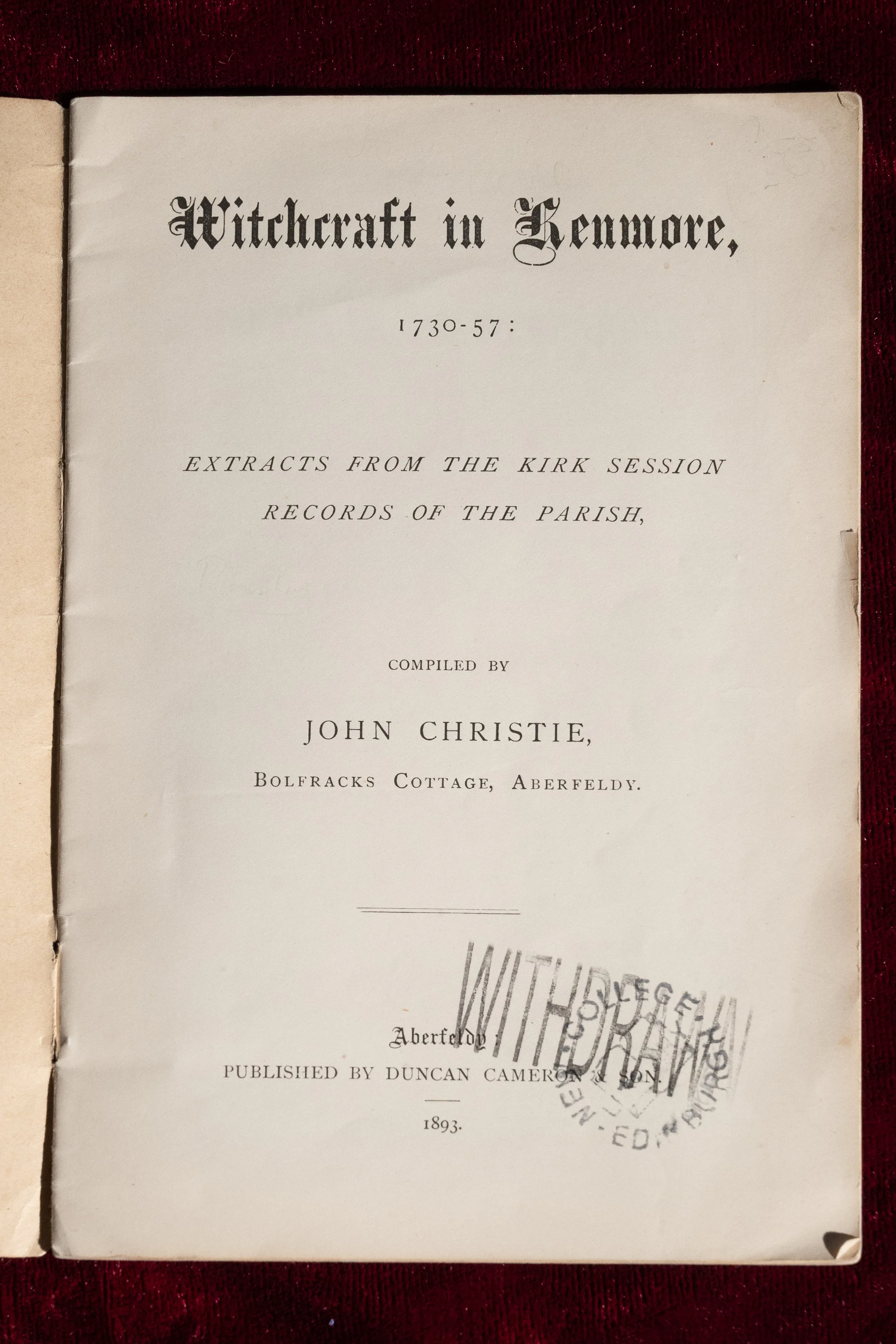 Image 2 of 5
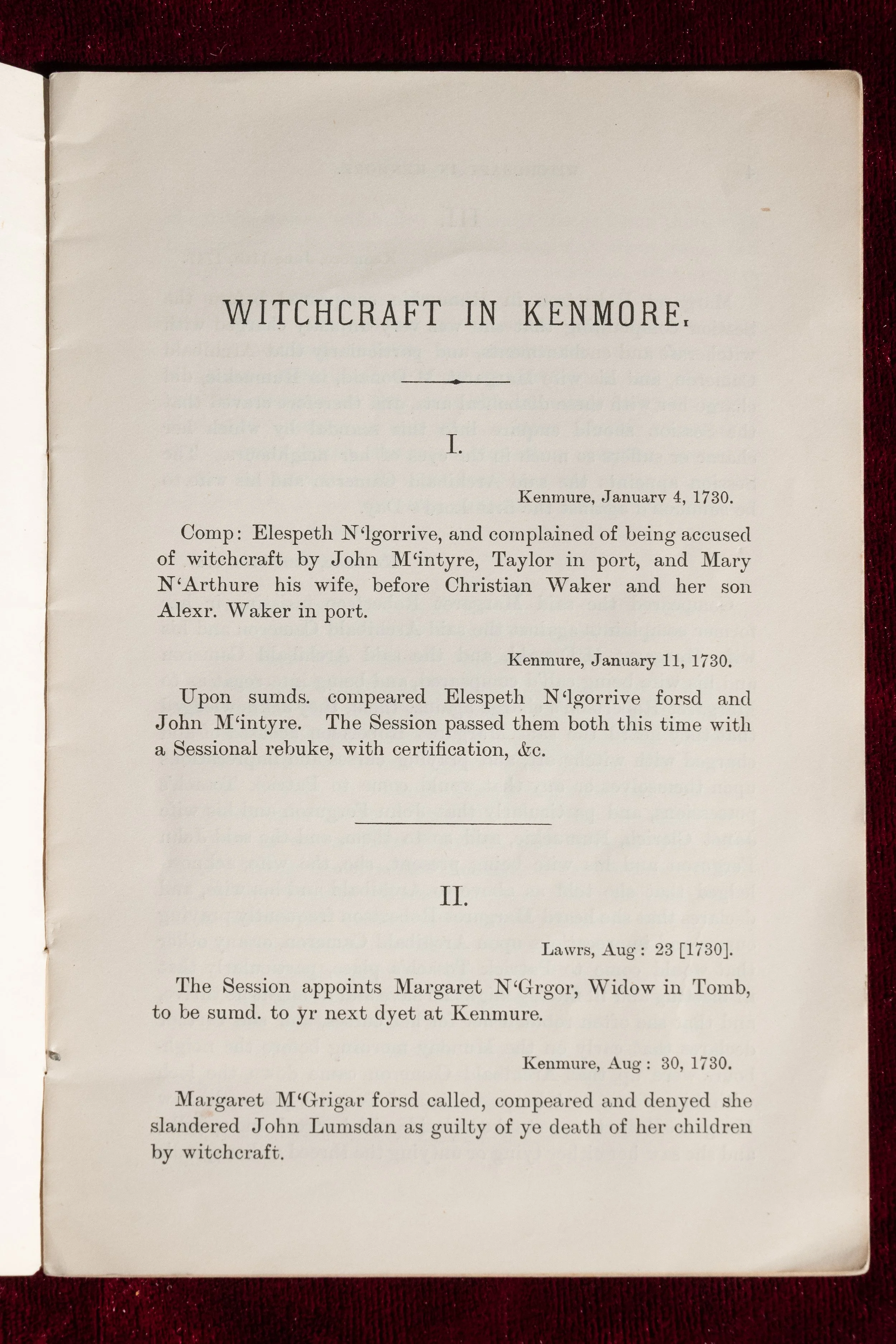 Image 3 of 5
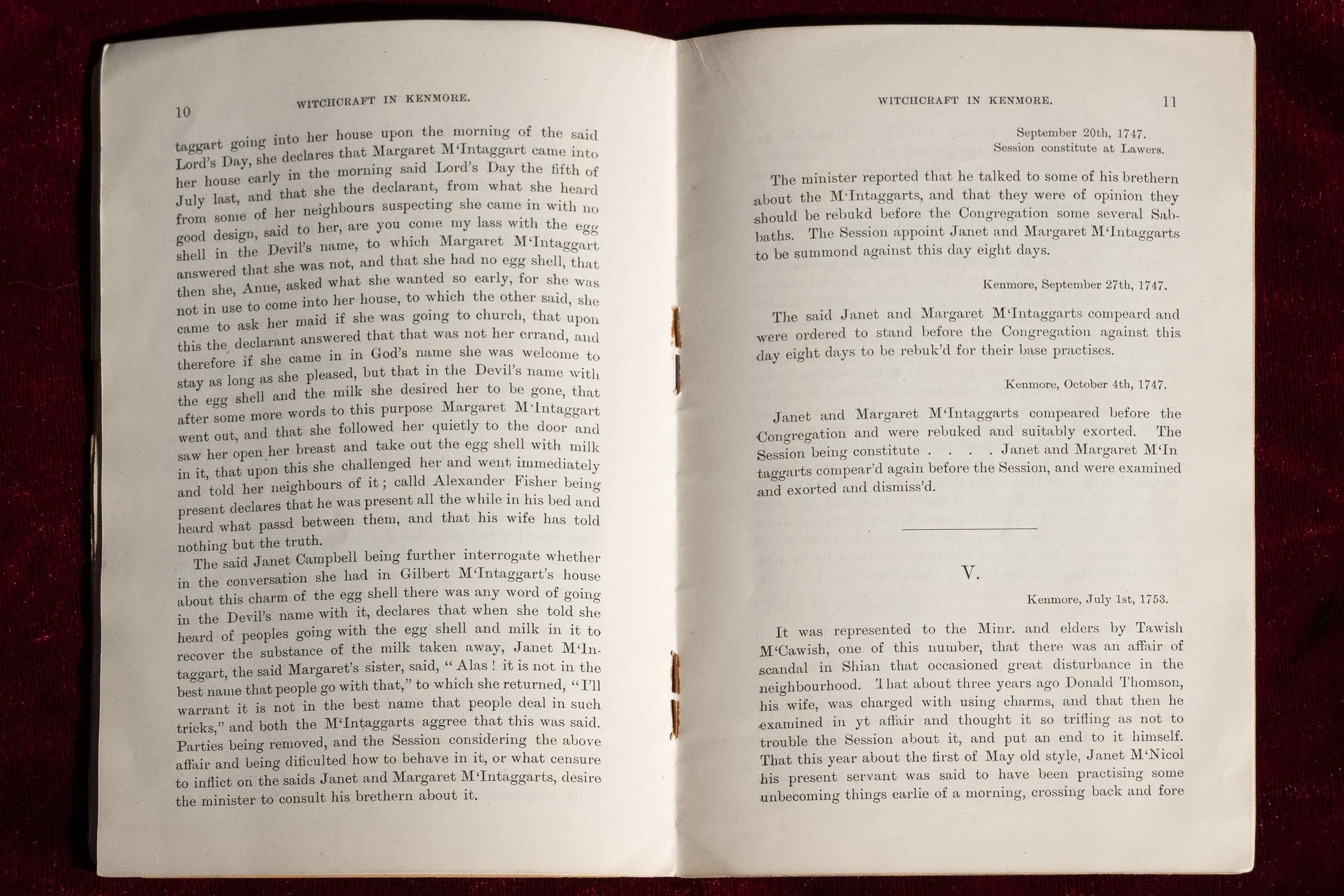 Image 4 of 5
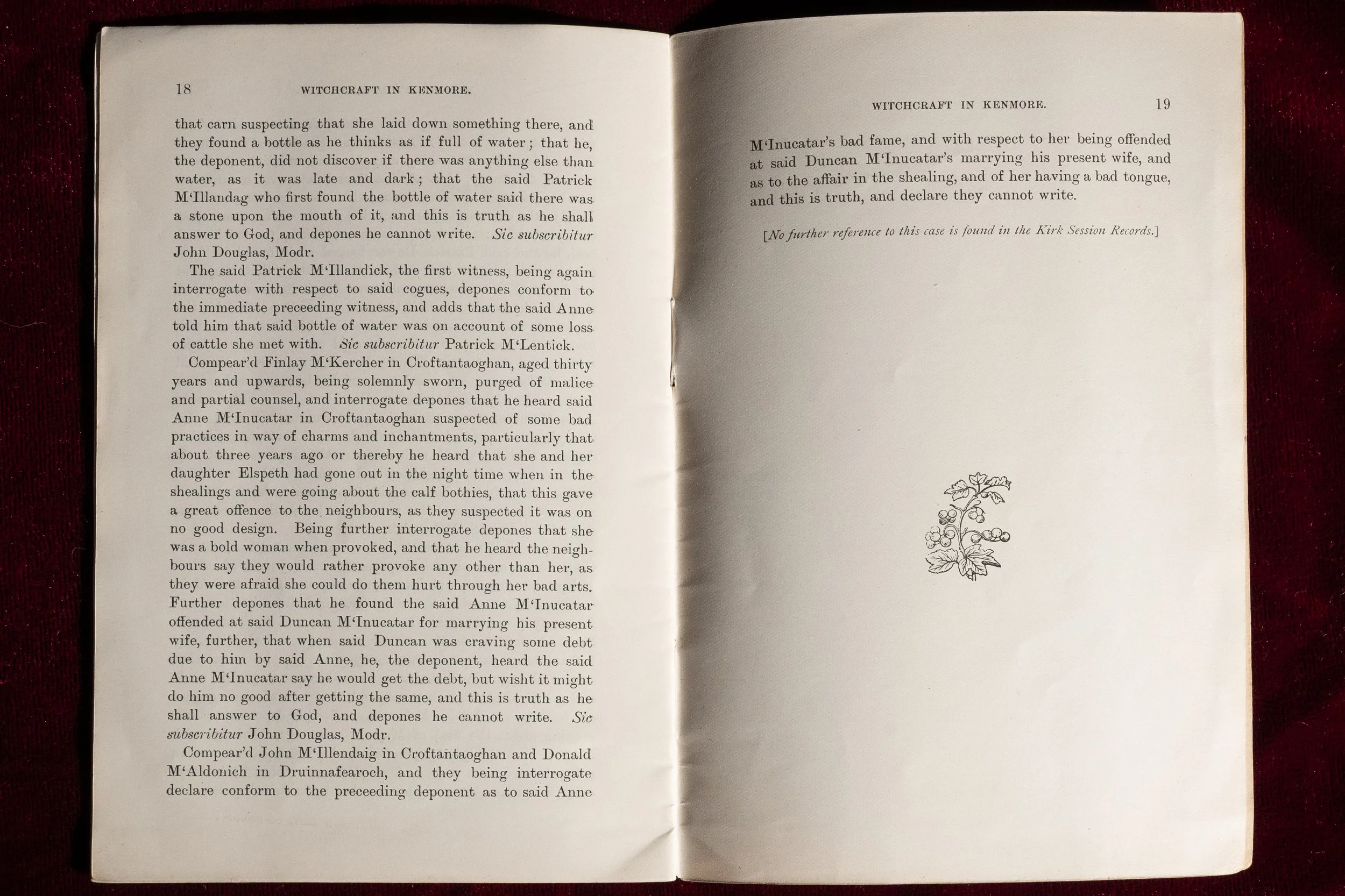 Image 5 of 5
For all the menace the word carries, witchcraft in eighteenth-century Kenmore turns out to be a quieter and stranger thing than the title promises. The cases John Christie transcribed from the kirk session book of this Perthshire parish on Loch Tay run from 1730 to 1757, which is to say they belong almost entirely to the period after Scotland had stopped killing witches. The last execution had taken place at Dornoch in 1727, and the Witchcraft Act of 1735 would soon redefine witchcraft in law not as a real and capital crime but as a pretended one, a species of fraud. What survives in these pages is therefore the long afterlife of the belief, handled not by the justiciary and the stake but by a parish court armed with nothing sharper than a public rebuke. The first surprise is who is doing the complaining. In the opening case of 1730 it is Elspeth NcIlgorrive who comes before the session, not as an accused witch but as an aggrieved neighbor, protesting that John M’Intyre the tailor and his wife had called her one. The session hears both parties and dismisses them with a mutual rebuke. Several of these entries are defamation suits of exactly this kind, the supposed witch demanding that the kirk clear her name. It is a quiet inversion of the popular image of the witch trial, and it tells us a good deal about how such accusations actually worked in a small community: as weapons in quarrels over debt, marriage, and slighted pride. When genuine practice does surface, it is the homely magic of the Highland farm rather than anything diabolical.
The longest and best case, from 1747, turns on an egg-shell. A woman is seen slipping into a neighbor’s house at dawn on the Lord’s Day and is met with the marvelous challenge, “are you come my lass with the egg shell in the Devil’s name”; she is told she is welcome in God’s name but not in the Devil’s, and is then watched as she opens her breast and draws out an egg-shell filled with milk, a charm to recover the “substance” of milk believed stolen from a neighbor’s cows. One of the sisters caught up in the affair supplies the entry’s wry moral: “Alas! it is not in the best name that people go with that.” The session’s answer was not the gallows but an order to stand before the congregation and be “suitably exorted.” Elsewhere a bottle of water, stopped with a stone, is found laid down at a cairn on account of lost cattle, and a servant is reported “crossing back and fore” suspiciously early of a morning. The vocabulary of the Devil, tellingly, is supplied almost entirely by the accusers and the clerk, not by the accused.
As an artifact the pamphlet is as unassuming as its contents. It was compiled by a local antiquary, Christie of Bolfracks Cottage, and printed in 1893 by a small Aberfeldy firm for an audience of Perthshire readers and folklorists; wire-stitched in plain printed wrappers, it is precisely the kind of ephemeral production that was meant to be read and thrown away. That is rather the point of collecting it. The text has since been digitised and survives in a handful of institutional copies, but the original pamphlet seldom appears in commerce, and it remains one of the more approachable primary witnesses to the disciplinary afterlife of Scottish witch belief: the moment at which the cunning-folk of a Gaelic-speaking glen passed, by way of the session clerk’s English, into the written record. Most of the witnesses, the clerk repeatedly notes, could not write their own names.
CHRISTIE, John (compiler). Witchcraft in Kenmore, 1730-57: Extracts from the Kirk Session Records of the Parish. Aberfeldy: Published by Duncan Cameron & Son, 1893. First edition. Physical Description: Octavo (180 x 125 mm). 19, [1] pp. A single gathering, wire-stitched as issued. Small wood-engraved tail-piece (a fruiting sprig) at the foot of the final page; the closing case ends with the editorial line, [No further reference to this case is found in the Kirk Session Records.]
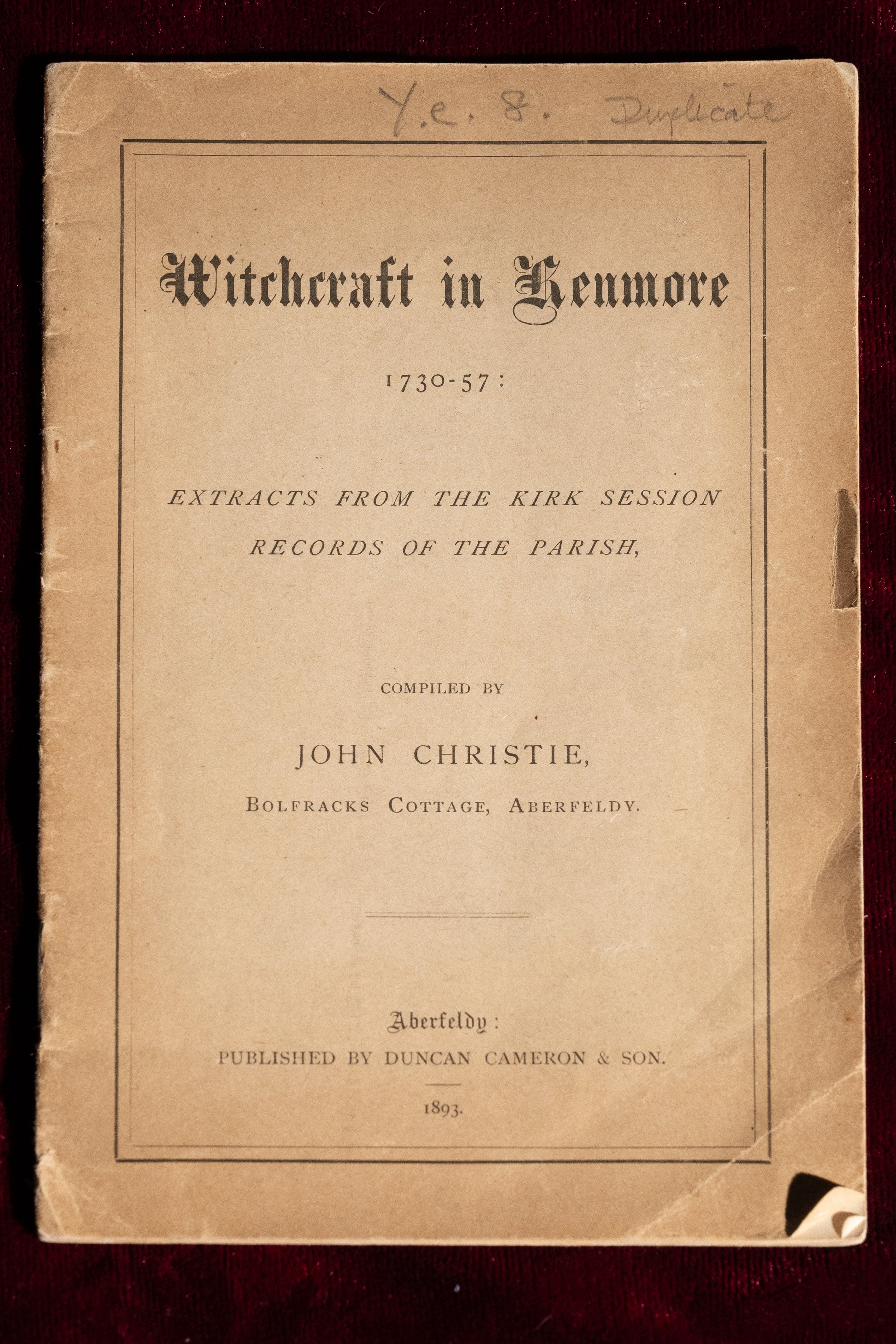
Binding: Original printed paper wrappers, the upper wrapper repeating the title within a double-rule frame.
Condition: Wrappers toned and lightly dust-soiled, with creasing and small chips and short tears at the corners (a short tear with slight loss to the lower outer corner of the upper wrapper). Staples oxidised, with light rust-staining at the inner margin of the central opening. Text clean and fresh throughout.
Provenance: Pencilled shelf-mark and note to the upper wrapper (“Y.e.8 … Duplicate”). Title page with a circular Edinburgh college library stamp, its wording only partly legible (“… COLLEGE LIBRARY … EDINBURGH”), cancelled with a “WITHDRAWN” handstamp. No other marks.
For all the menace the word carries, witchcraft in eighteenth-century Kenmore turns out to be a quieter and stranger thing than the title promises. The cases John Christie transcribed from the kirk session book of this Perthshire parish on Loch Tay run from 1730 to 1757, which is to say they belong almost entirely to the period after Scotland had stopped killing witches. The last execution had taken place at Dornoch in 1727, and the Witchcraft Act of 1735 would soon redefine witchcraft in law not as a real and capital crime but as a pretended one, a species of fraud. What survives in these pages is therefore the long afterlife of the belief, handled not by the justiciary and the stake but by a parish court armed with nothing sharper than a public rebuke. The first surprise is who is doing the complaining. In the opening case of 1730 it is Elspeth NcIlgorrive who comes before the session, not as an accused witch but as an aggrieved neighbor, protesting that John M’Intyre the tailor and his wife had called her one. The session hears both parties and dismisses them with a mutual rebuke. Several of these entries are defamation suits of exactly this kind, the supposed witch demanding that the kirk clear her name. It is a quiet inversion of the popular image of the witch trial, and it tells us a good deal about how such accusations actually worked in a small community: as weapons in quarrels over debt, marriage, and slighted pride. When genuine practice does surface, it is the homely magic of the Highland farm rather than anything diabolical.
The longest and best case, from 1747, turns on an egg-shell. A woman is seen slipping into a neighbor’s house at dawn on the Lord’s Day and is met with the marvelous challenge, “are you come my lass with the egg shell in the Devil’s name”; she is told she is welcome in God’s name but not in the Devil’s, and is then watched as she opens her breast and draws out an egg-shell filled with milk, a charm to recover the “substance” of milk believed stolen from a neighbor’s cows. One of the sisters caught up in the affair supplies the entry’s wry moral: “Alas! it is not in the best name that people go with that.” The session’s answer was not the gallows but an order to stand before the congregation and be “suitably exorted.” Elsewhere a bottle of water, stopped with a stone, is found laid down at a cairn on account of lost cattle, and a servant is reported “crossing back and fore” suspiciously early of a morning. The vocabulary of the Devil, tellingly, is supplied almost entirely by the accusers and the clerk, not by the accused.
As an artifact the pamphlet is as unassuming as its contents. It was compiled by a local antiquary, Christie of Bolfracks Cottage, and printed in 1893 by a small Aberfeldy firm for an audience of Perthshire readers and folklorists; wire-stitched in plain printed wrappers, it is precisely the kind of ephemeral production that was meant to be read and thrown away. That is rather the point of collecting it. The text has since been digitised and survives in a handful of institutional copies, but the original pamphlet seldom appears in commerce, and it remains one of the more approachable primary witnesses to the disciplinary afterlife of Scottish witch belief: the moment at which the cunning-folk of a Gaelic-speaking glen passed, by way of the session clerk’s English, into the written record. Most of the witnesses, the clerk repeatedly notes, could not write their own names.
CHRISTIE, John (compiler). Witchcraft in Kenmore, 1730-57: Extracts from the Kirk Session Records of the Parish. Aberfeldy: Published by Duncan Cameron & Son, 1893. First edition. Physical Description: Octavo (180 x 125 mm). 19, [1] pp. A single gathering, wire-stitched as issued. Small wood-engraved tail-piece (a fruiting sprig) at the foot of the final page; the closing case ends with the editorial line, [No further reference to this case is found in the Kirk Session Records.]
Binding: Original printed paper wrappers, the upper wrapper repeating the title within a double-rule frame.
Condition: Wrappers toned and lightly dust-soiled, with creasing and small chips and short tears at the corners (a short tear with slight loss to the lower outer corner of the upper wrapper). Staples oxidised, with light rust-staining at the inner margin of the central opening. Text clean and fresh throughout.
Provenance: Pencilled shelf-mark and note to the upper wrapper (“Y.e.8 … Duplicate”). Title page with a circular Edinburgh college library stamp, its wording only partly legible (“… COLLEGE LIBRARY … EDINBURGH”), cancelled with a “WITHDRAWN” handstamp. No other marks.