Before there was a Rider-Waite, before the Tarot de Marseille was pressed into occult service, there was Etteilla. Jean-Baptiste Alliette (1738-1791), a Paris print-seller who reversed his surname into a magical pseudonym, was the first person to make a living reading tarot cards, and in 1789 he issued the first tarot ever designed for divination rather than card play. Convinced, following Court de Gébelin, that the tarot concealed the ancient Egyptian Book of Thoth, he rebuilt the deck from the ground up: renumbered 1 to 78, reordered around the days of Creation and the four elements, and fitted with printed keywords at both ends of each card, one meaning upright, another reversed. This is that deck, the so-called Grand Etteilla, in the handsome edition published by B. P. Grimaud of Paris around the close of the nineteenth century, and it remains the direct ancestor of every fortune-telling deck that prints its meanings on the cards.
The cards themselves are full of strange and wonderful machinery. Card 1, the Questionnant, shows the male questioner as a primordial chaos of cloud and bursting sun; card 5, Voyage, carries the four beasts of the apocalypse arranged around an ouroboros serpent enclosing Eve between two pyramids, with zodiacal sigils in the corners and the cryptic headers "4. El." and "6. Cré.," the fourth element and the sixth day of Creation. The Fool, here Folie, numbered 0 and 78 at once, trudges past a curious spotted dog with his bundle on a stick. Alongside the allegorical trumps run the practical cards a working fortune-teller actually consulted: Maladie, Veuvage, Grossesse, Homme Blond and Femme Brune, Méchante Femme, Homme Vicieux, the whole social comedy of the consulting room laid out in stenciled color. The reversible titles let the reader deliver good news or bad with a turn of the wrist: Expédition becomes Réussite, Nouvelles Connaissances sours into Ennui.
Grimaud, the great Paris card house founded in 1848, printed this edition from its works at 54 rue de Lancry, the address that appears on the surviving wrapper. The cards are chromolithographed and stencil-colored in the bright pinks, blues, and golds characteristic of the firm's finest period, with single black-line borders, square corners, and backs in a dense blue pinwheel diaper. With the deck survive two fragments of its original dress: a portion of the pictorial wrapper, printed with hands brandishing swords above a chalice and planetary sigils and titled "Grand Etteilla, 78 Cartes, B.P. Grimaud, Paris, 54 Rue de Lancry," and the printed paper band, which carries an old ink inscription in a French hand. Such ephemeral packaging was nearly always discarded, and even fragments are uncommon survivals.
The deck is in notably fresh condition for a working divination tool, the cards clean and bright with sharp corners, suggesting it spent its life consulted gently or admired rather than shuffled to death. Antique Etteilla decks of this vintage are keenly sought by collectors of both tarot and French popular print, and complete 78-card examples appear in commerce only occasionally; most survivors are broken sets. For the collector of Western esotericism this is a cornerstone object: the deck that carried the Egyptian myth of the tarot, and the very practice of card reading as a profession, from the eighteenth century into the modern occult revival.
[ALLIETTE, Jean-Baptiste, called ETTEILLA (1738-1791), after]. Grand Etteilla, 78 Cartes [Grand Etteilla I, "Tarots Égyptiens" type]. Paris: B. P. Grimaud, 54 rue de Lancry, circa 1890-1910.
Physical Description: Complete deck of 78 chromolithographed and stencil-colored cards, approx. 119 x 66 mm, square corners, single black-line borders; each card numbered with double-ended French titles for upright and reversed readings; backs printed in a blue pinwheel pattern. With two fragments of the original printed pictorial wrapper and the publisher's paper band bearing an early ink inscription.
Condition: Cards very fresh, clean and bright, corners sharp, color strong. Wrapper and band fragmentary as described, with losses, creasing, and old folds.
Provenance: Early French ink inscription on the wrapper band, only partly legible.
Before there was a Rider-Waite, before the Tarot de Marseille was pressed into occult service, there was Etteilla. Jean-Baptiste Alliette (1738-1791), a Paris print-seller who reversed his surname into a magical pseudonym, was the first person to make a living reading tarot cards, and in 1789 he issued the first tarot ever designed for divination rather than card play. Convinced, following Court de Gébelin, that the tarot concealed the ancient Egyptian Book of Thoth, he rebuilt the deck from the ground up: renumbered 1 to 78, reordered around the days of Creation and the four elements, and fitted with printed keywords at both ends of each card, one meaning upright, another reversed. This is that deck, the so-called Grand Etteilla, in the handsome edition published by B. P. Grimaud of Paris around the close of the nineteenth century, and it remains the direct ancestor of every fortune-telling deck that prints its meanings on the cards.
The cards themselves are full of strange and wonderful machinery. Card 1, the Questionnant, shows the male questioner as a primordial chaos of cloud and bursting sun; card 5, Voyage, carries the four beasts of the apocalypse arranged around an ouroboros serpent enclosing Eve between two pyramids, with zodiacal sigils in the corners and the cryptic headers "4. El." and "6. Cré.," the fourth element and the sixth day of Creation. The Fool, here Folie, numbered 0 and 78 at once, trudges past a curious spotted dog with his bundle on a stick. Alongside the allegorical trumps run the practical cards a working fortune-teller actually consulted: Maladie, Veuvage, Grossesse, Homme Blond and Femme Brune, Méchante Femme, Homme Vicieux, the whole social comedy of the consulting room laid out in stenciled color. The reversible titles let the reader deliver good news or bad with a turn of the wrist: Expédition becomes Réussite, Nouvelles Connaissances sours into Ennui.
Grimaud, the great Paris card house founded in 1848, printed this edition from its works at 54 rue de Lancry, the address that appears on the surviving wrapper. The cards are chromolithographed and stencil-colored in the bright pinks, blues, and golds characteristic of the firm's finest period, with single black-line borders, square corners, and backs in a dense blue pinwheel diaper. With the deck survive two fragments of its original dress: a portion of the pictorial wrapper, printed with hands brandishing swords above a chalice and planetary sigils and titled "Grand Etteilla, 78 Cartes, B.P. Grimaud, Paris, 54 Rue de Lancry," and the printed paper band, which carries an old ink inscription in a French hand. Such ephemeral packaging was nearly always discarded, and even fragments are uncommon survivals.
The deck is in notably fresh condition for a working divination tool, the cards clean and bright with sharp corners, suggesting it spent its life consulted gently or admired rather than shuffled to death. Antique Etteilla decks of this vintage are keenly sought by collectors of both tarot and French popular print, and complete 78-card examples appear in commerce only occasionally; most survivors are broken sets. For the collector of Western esotericism this is a cornerstone object: the deck that carried the Egyptian myth of the tarot, and the very practice of card reading as a profession, from the eighteenth century into the modern occult revival.
[ALLIETTE, Jean-Baptiste, called ETTEILLA (1738-1791), after]. Grand Etteilla, 78 Cartes [Grand Etteilla I, "Tarots Égyptiens" type]. Paris: B. P. Grimaud, 54 rue de Lancry, circa 1890-1910.
Physical Description: Complete deck of 78 chromolithographed and stencil-colored cards, approx. 119 x 66 mm, square corners, single black-line borders; each card numbered with double-ended French titles for upright and reversed readings; backs printed in a blue pinwheel pattern. With two fragments of the original printed pictorial wrapper and the publisher's paper band bearing an early ink inscription.
Condition: Cards very fresh, clean and bright, corners sharp, color strong. Wrapper and band fragmentary as described, with losses, creasing, and old folds.
Provenance: Early French ink inscription on the wrapper band, only partly legible.

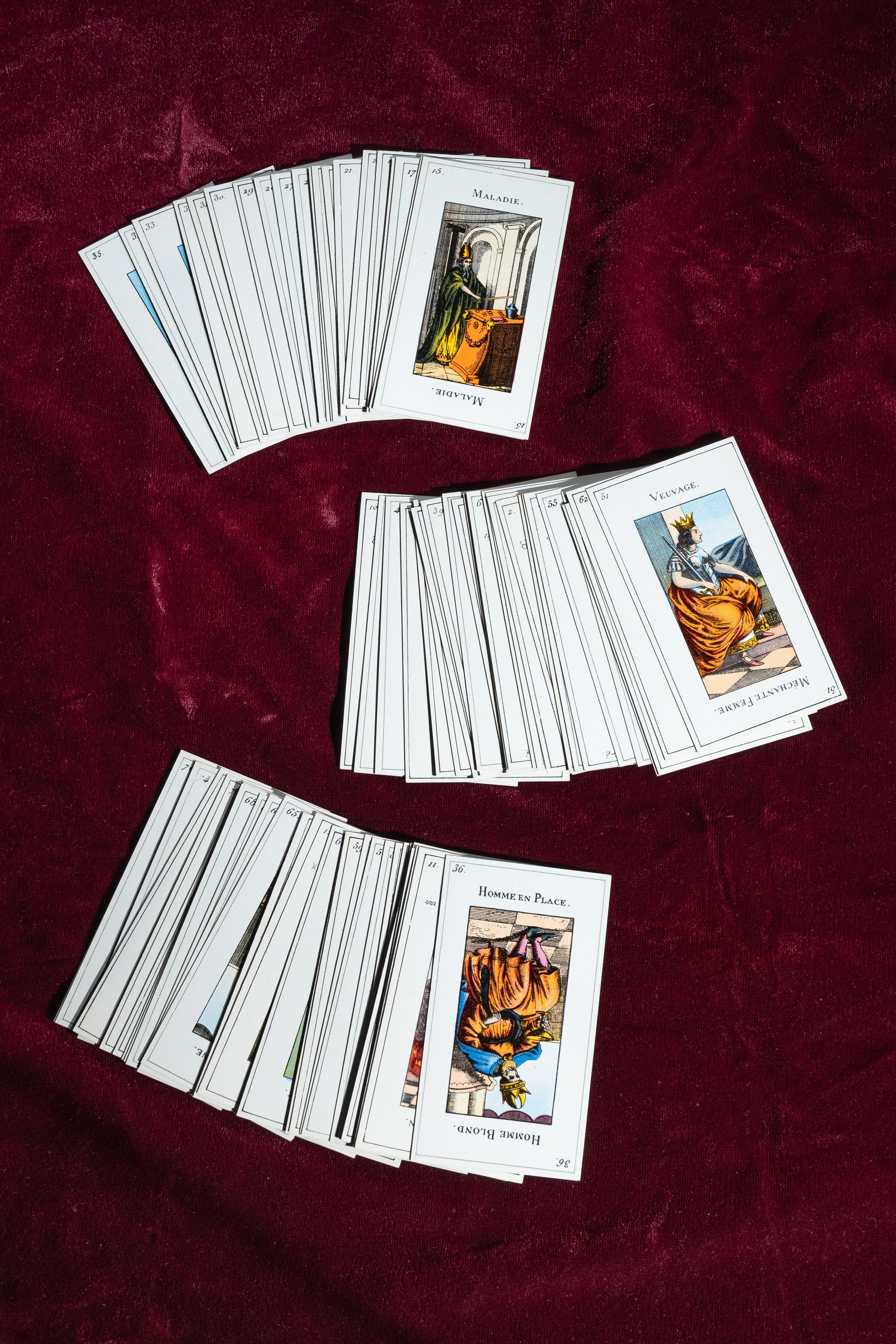 Image 1 of 6
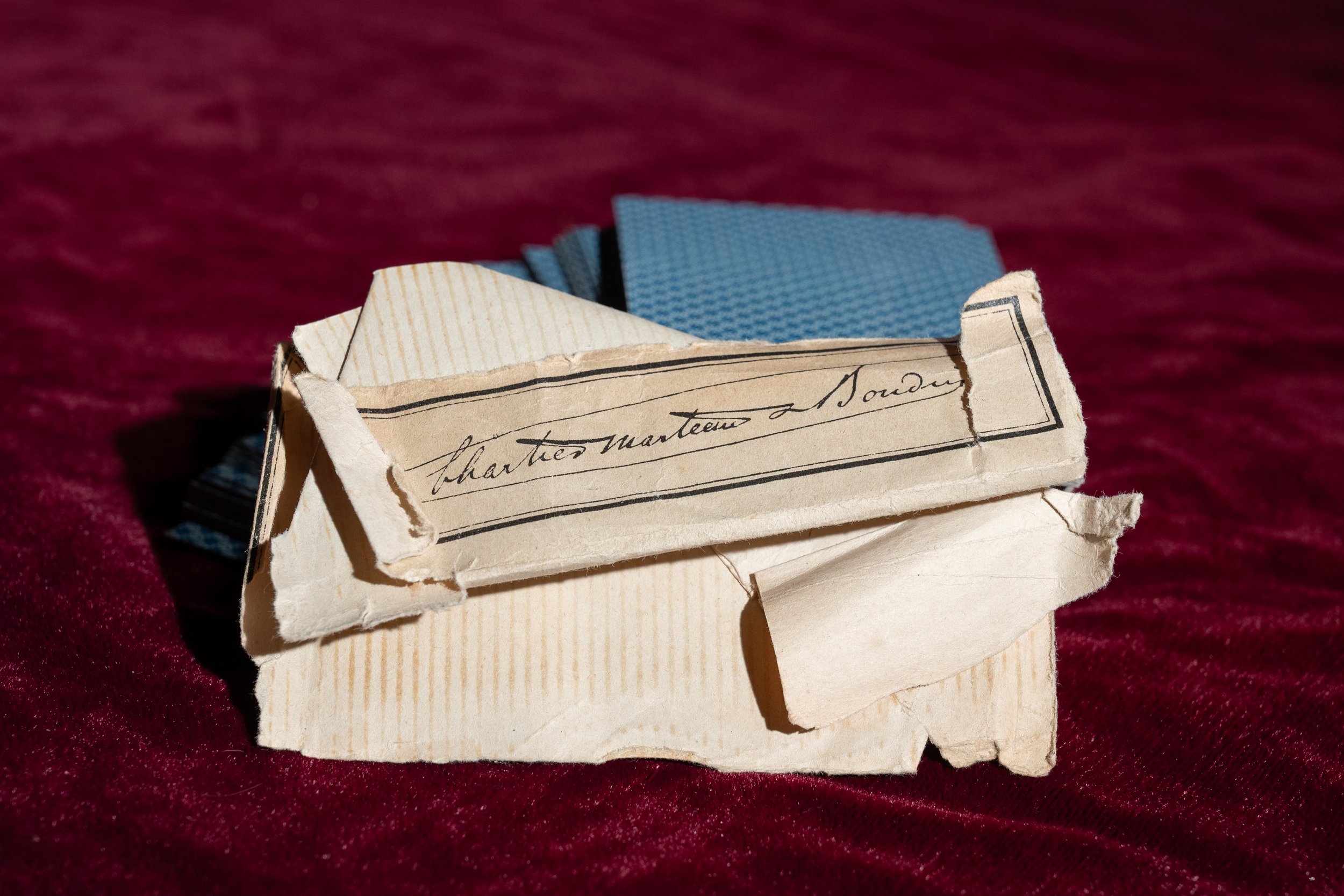 Image 2 of 6
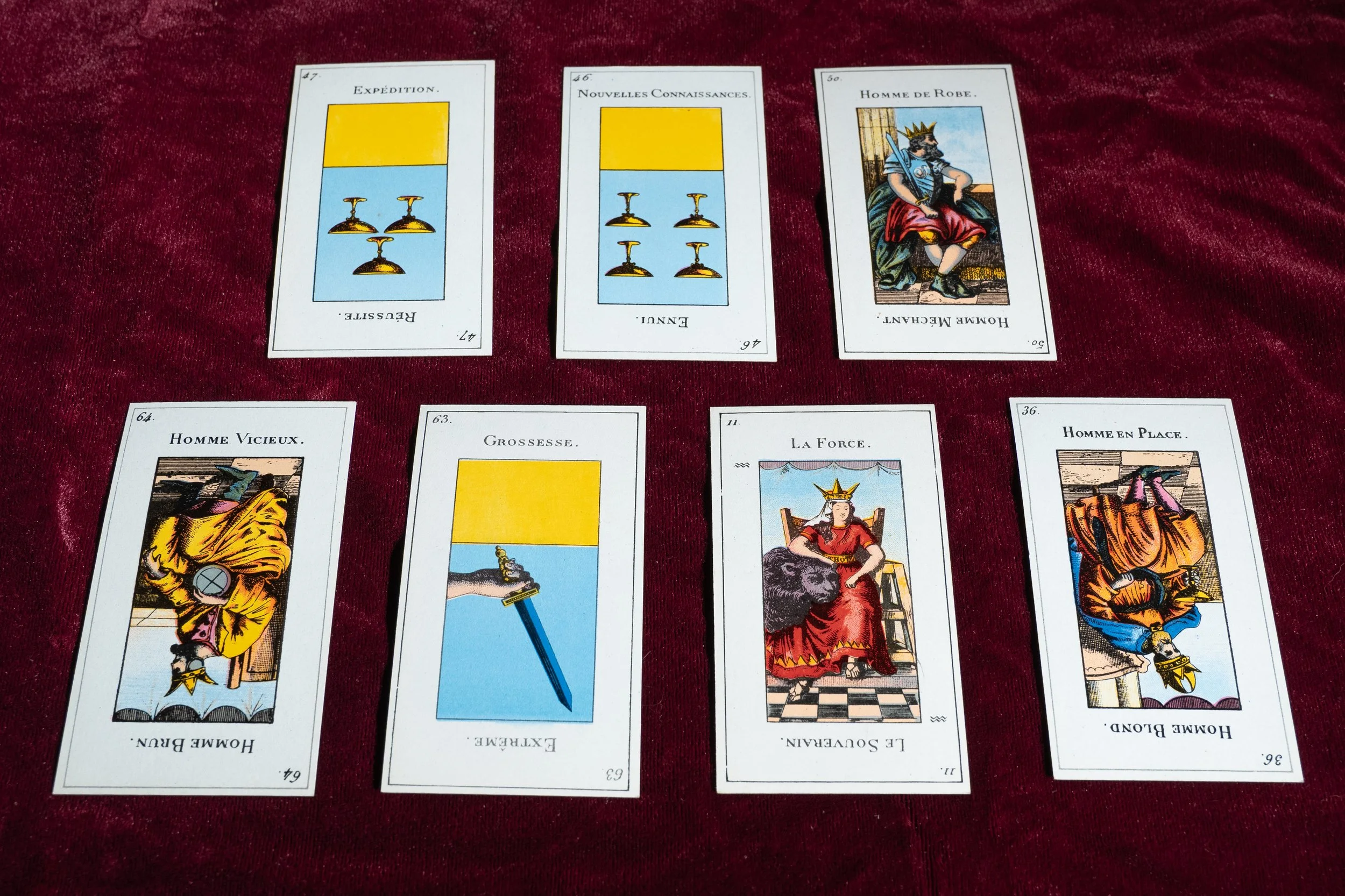 Image 3 of 6
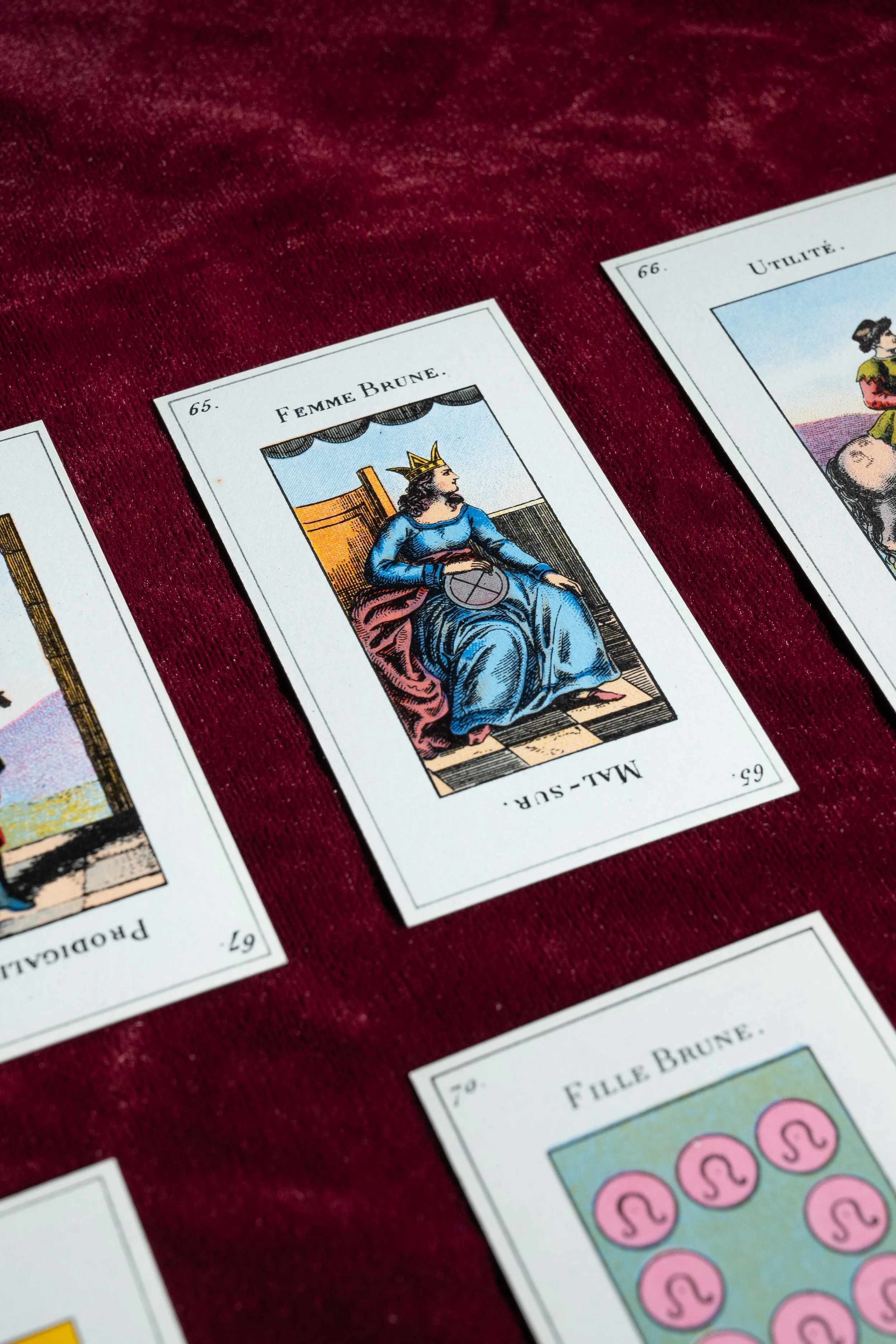 Image 4 of 6
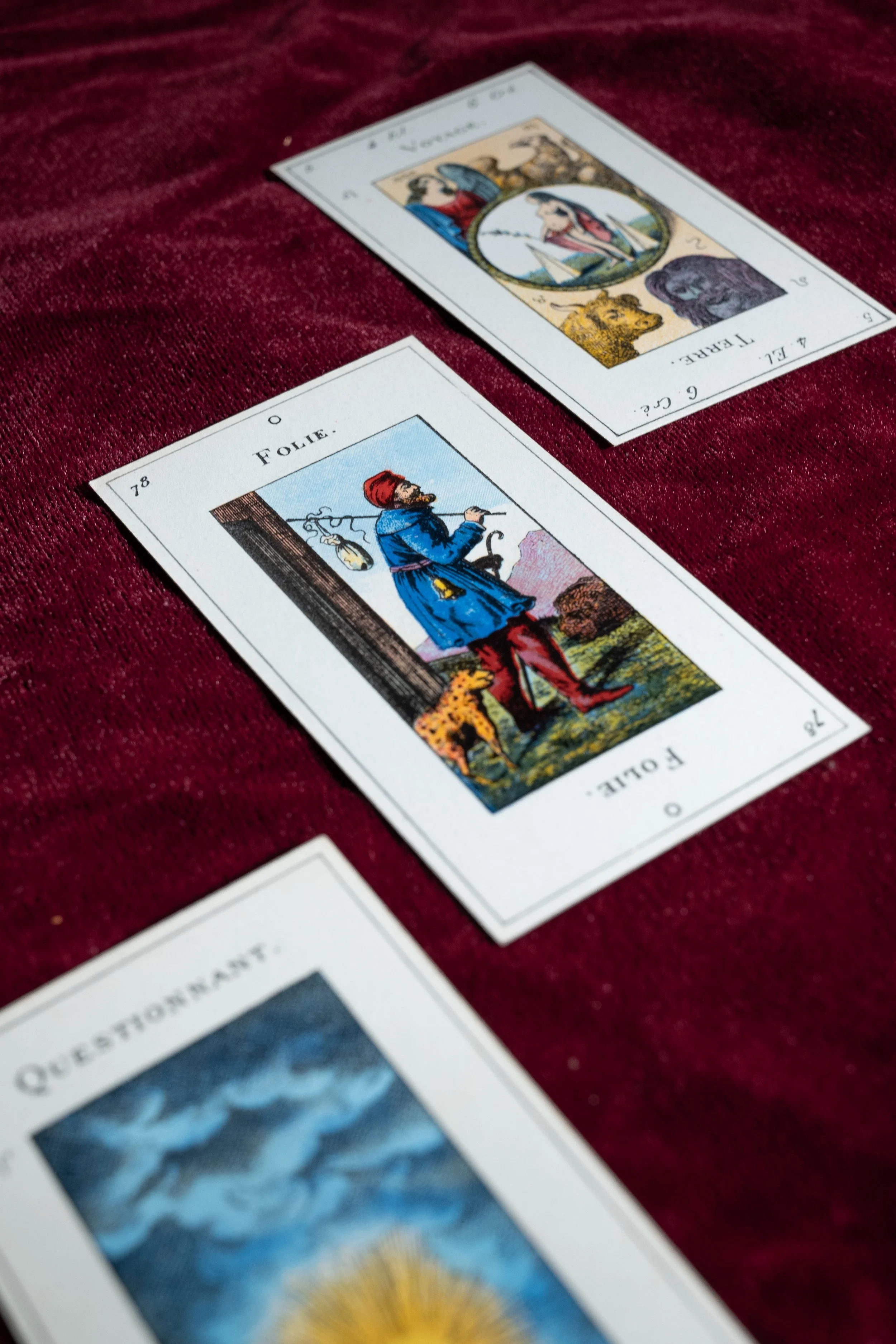 Image 5 of 6
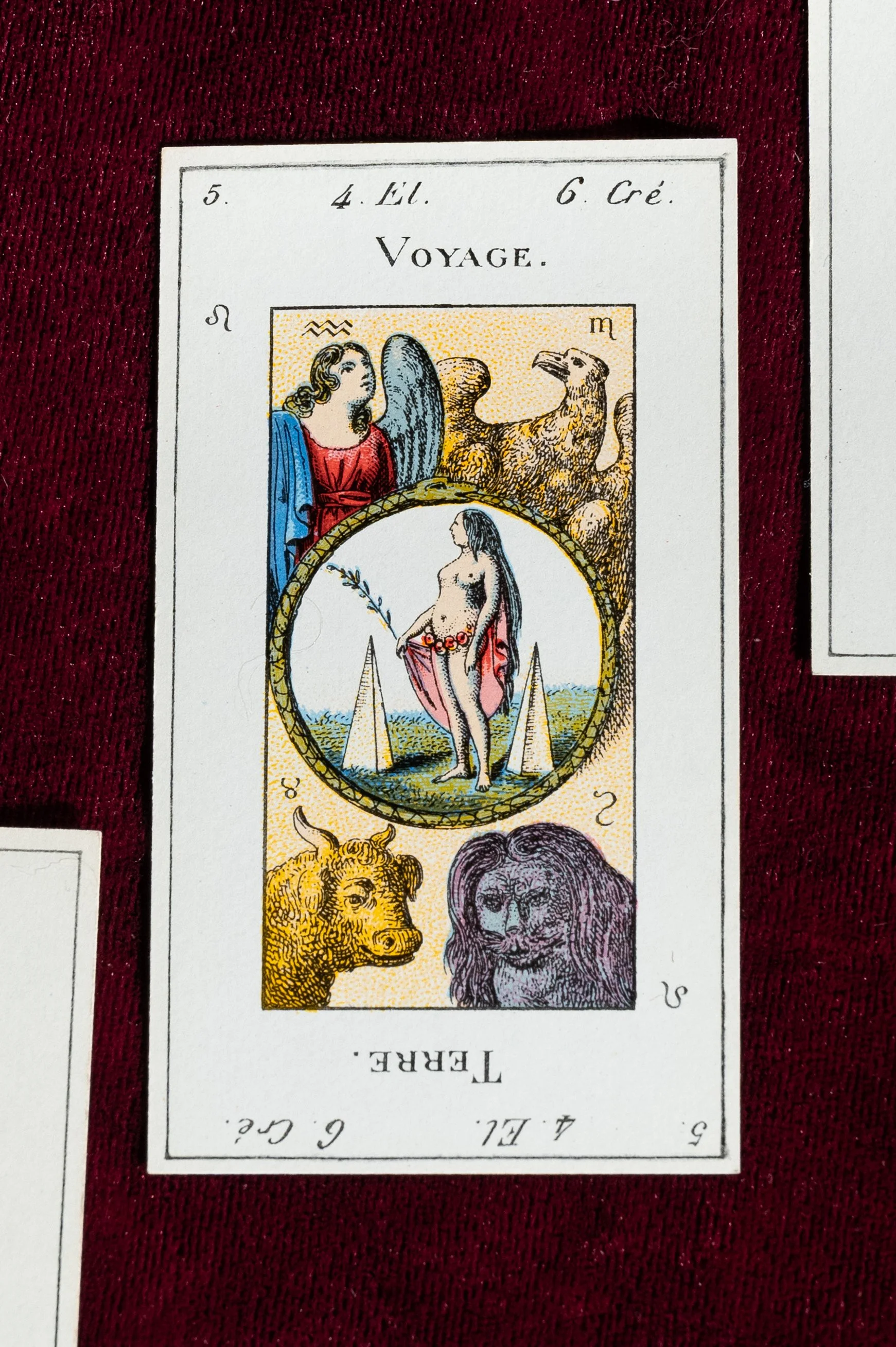 Image 6 of 6